
Delegating work is easy. Knowing it was actually completed — and completed properly — is the harder part. In most jewelry businesses, tasks get handed out verbally or over a message, and the only way to confirm they’re done is to ask. There’s no record of who was responsible, what stage it’s at, or whether anyone checked the work before calling it finished. SocioLedger’s Task Management is built to close that gap with structured task delegation, a four-stage visual board, and an integrated review step.
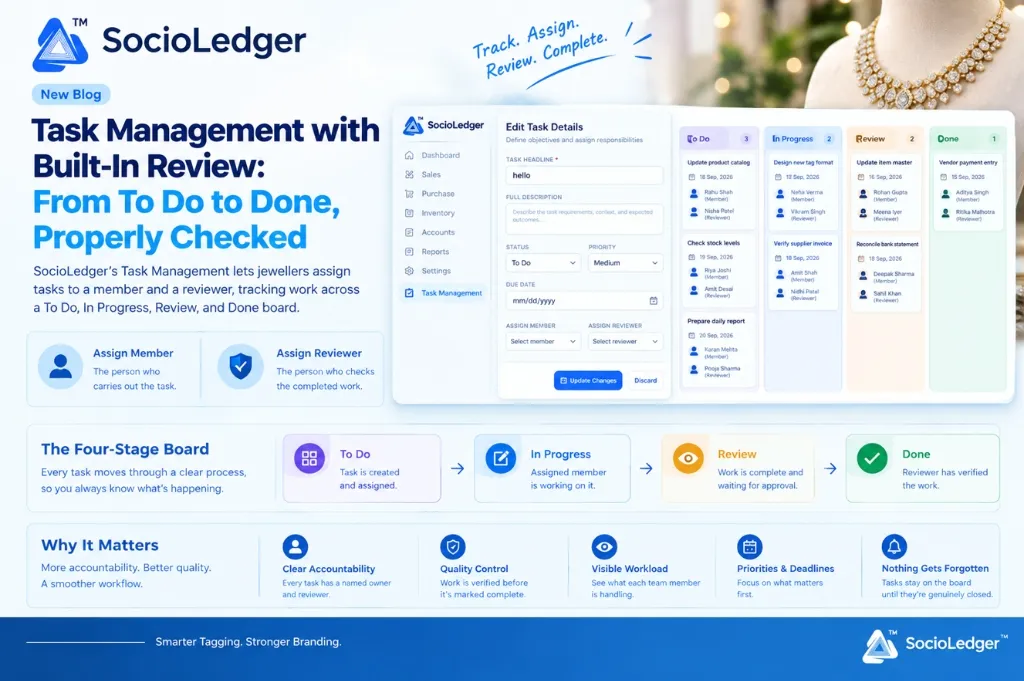
Table of contents
Open Table of contents
- Why informal task delegation breaks down in jewelry showrooms
- The two-role delegation model: Member and Reviewer
- The four-stage board: Visual tracking from To Do to Done
- Task details that provide complete context
- Why built-in review matters: 5 key operational benefits
- Where to find Task Management in SocioLedger
- Structure for the work behind the counter
Why informal task delegation breaks down in jewelry showrooms
In busy jewelry hubs like Zaveri Bazaar, Karol Bagh, CG Road, and Surat, showroom floors and back offices move at high speed. Between attending walk-in clients, managing diamond selections, balancing cash registers, and coordinating with karigar workshops, dozens of operational tasks arise every day.
Historically, these tasks get handed out through quick floor conversations or informal WhatsApp messages:
- “Please check the stock counts on the bridal necklace trays before this evening.”
- “Verify the metal purity and weight on the new vendor invoice from the casting unit.”
- “Reconcile the daily bank deposit and match it against our fine gold rate cuts.”
- “Update the master catalog tags for the upcoming weekend exhibition.”
While informal delegation feels convenient in the moment, it creates serious operational vulnerabilities as soon as footfall increases. When instructions live in chat threads or memory, three common problems emerge:
- Self-reported completion without verification: An employee marks a task “done” to clear their queue, but errors in weight calculations, missing HUID hallmarks, or mismatched ledger entries slip through unnoticed.
- Ambiguous responsibility: When a task stalls, nobody knows whether the delay is with the person executing the work or the manager supposed to approve it.
- Lost context and missed deadlines: Important back-office duties get pushed aside by urgent walk-ins, staying forgotten until an audit discrepancy or customer complaint surfaces.
Clear delegation requires more than just assigning an owner — it requires an automated system of accountability and verification.
The two-role delegation model: Member and Reviewer
Standard to-do lists fail in jewelry retail and manufacturing because they rely entirely on single-person self-reporting. An employee marks a task complete, and the system assumes everything is accurate. In high-value jewelry operations, where a single typo in gross weight or purity rate can cost thousands of rupees, self-reporting is a major risk.
+-----------------------------------------------------------------------------+
|               SocioLedger Two-Role Task Delegation Model                    |
+-----------------------------------------------------------------------------+
|  [ Assign Member ]   --> Carries out the work & submits for verification   |
|                                     │                                       |
|                                     ▼                                       |
|  [ Assign Reviewer ] --> Inspects deliverable, audits data & approves       |
+-----------------------------------------------------------------------------+
SocioLedger’s Task Management introduces two distinct roles for every single task:
1. Assign Member
The Assign Member is the person responsible for executing the task on the ground. Whether it is scanning incoming ornament tags, generating customer quotations, updating CAD catalog images, or preparing daily stock tally sheets, the assigned member has direct ownership over getting the job done.
2. Assign Reviewer
The Assign Reviewer is the designated quality checker who verifies the completed work before it can be closed. This is often a floor manager, head accountant, inventory supervisor, or store owner.
Work cannot jump directly from in-progress to finished on the word of a single person. The reviewer must inspect the output, confirm accuracy against source records, and formally approve the task.
Real-world examples of dual-role delegation
This structure mirrors how high-performing jewelry operations function in practice:
- Vendor Invoice Verification: Member (Accounts Assistant) enters vendor bills; Reviewer (Senior Accountant) checks purity rates and gold weights against physical receipts.
- Showroom Tray Audit: Member (Counter Executive) scans tray barcodes; Reviewer (Floor Supervisor) verifies zero weight variances before locking the display counter.
- Catalog Tag Updates: Member (Design Assistant) enters new product dimensions; Reviewer (Store Manager) checks formatting and pricing formulas before tags go to the printer.
Adding a dedicated review step turns routine delegation into an active quality control checkpoint.
The four-stage board: Visual tracking from To Do to Done
Every task created in SocioLedger moves across a structured four-stage kanban board. Instead of searching through messaging groups or asking staff for verbal status updates, managers and team members can view the entire showroom workflow at a glance.
+-----------------------------------------------------------------------------+
|                          The Four-Stage Board Flow                          |
+-----------------------------------------------------------------------------+
|  ┌─────────────┐     ┌─────────────┐     ┌─────────────┐     ┌─────────────┐|
|  │    To Do    │ ──> │ In Progress │ ──> │   Review    │ ──> │    Done     │|
|  │  (Assigned) │     │  (Working)  │     │  (Auditing) │     │ (Completed) │|
|  └─────────────┘     └─────────────┘     └─────────────┘     └─────────────┘|
+-----------------------------------------------------------------------------+
The board is divided into four transparent stages:
1. To Do
The task has been created with clear requirements, deadlines, priority, and assigned personnel, but execution has not yet started. Team members can view their upcoming priorities and schedule their day accordingly.
2. In Progress
The assigned member is actively working on the task. Moving a card to In Progress signals to managers and colleagues that the task is underway, preventing duplicate effort and establishing clear timelines.
3. Review
The assigned member has finished the work and submitted it for inspection. The card moves to the Review column, notifying the reviewer that the deliverable is ready for inspection. The task remains in this stage until the reviewer validates the output.
4. Done
The reviewer has verified the work, confirmed compliance and accuracy, and approved completion. The task is officially closed with a complete audit trail of who performed the work and who signed off on it.
A visual board gives everyone immediate visibility into what is pending, what is in progress, and what is awaiting approval.
Task details that provide complete context
Vague instructions lead to sloppy execution. SocioLedger’s task creation screen captures all necessary parameters upfront, so employees have full context without needing back-and-forth clarification.
+-----------------------------------------------------------------------------+
|                            Edit Task Details Screen                         |
+-----------------------------------------------------------------------------+
|  TASK HEADLINE    : [ Reconcile Bank Statement & Bullion Rate Cuts        ] |
|  FULL DESCRIPTION : [ Match bank deposits against gold purchase vouchers  ] |
|                     [ and verify closing fine gold balances for 18 Sep.   ] |
|  STATUS           : [ In Progress ▼ ]      PRIORITY        : [ High     ▼ ] |
|  DUE DATE         : [ 19 Sep, 2026  ]                                       |
|  ASSIGN MEMBER    : [ Deepak Sharma ▼ ]    ASSIGN REVIEWER : [ Sahil Khan ▼ ] |
+-----------------------------------------------------------------------------+
Each task record includes:
- Task Headline — A concise, clear title summarizing the core objective (e.g., “Design new tag format”, “Verify supplier invoice”).
- Full Description — Comprehensive instructions, reference numbers, expected deliverables, and special guidelines so the assignee is never left guessing.
- Status — Current location on the four-stage board (
To Do,In Progress,Review, orDone). - Priority — Explicit urgency rating (
Low,Medium,High,Urgent), helping team members prioritize critical jobs during peak trading hours. - Due Date — A firm completion deadline to keep showroom operations aligned with business milestones.
- Assigned Member and Reviewer — Named individuals responsible for execution and verification.
When all required details are captured upfront, staff members spend less time asking questions and more time executing accurately.
Why built-in review matters: 5 key operational benefits
Integrating task delegation and review directly into your jewelry ERP delivers measurable improvements to showroom productivity and operational precision:
1. Clear accountability
Every task has a single named owner and a single named reviewer. If a deadline slips or a deliverable has errors, there is zero ambiguity about who handled the work and who approved it.
2. Quality control built into daily operations
The dedicated review stage ensures that no operational task is closed based solely on self-reporting. Calculations, stock adjustments, customer entries, and ledger postings are double-checked by a qualified reviewer before being marked complete.
3. Balanced workload distribution
Store owners and floor managers can look at the four-stage board to see exactly how many tasks are assigned to each employee. This visual clarity helps managers distribute work evenly and prevent employee burnout during festival rushes.
4. Deadlines and priorities in one central hub
Urgent customer follow-ups and time-sensitive supplier settlements receive clear priority tags and due dates. Counter staff know exactly what needs attention first thing in the morning versus what can wait until the afternoon.
5. Zero forgotten tasks
Informal instructions given on the showroom floor frequently slip through the cracks. On SocioLedger’s board, every card stays visible until it is verified and formally closed by the reviewer.
| Operational Dimension | Informal Floor Delegation | SocioLedger Task Management |
|---|---|---|
| Assignment Method | Verbal requests, WhatsApp messages | Structured ERP task card with full context |
| Accountability | Unclear; easy to deflect responsibility | Named Member (executor) & named Reviewer (checker) |
| Quality Verification | None; self-reported as done | Mandatory review stage before task closure |
| Status Visibility | Requires asking staff or calling them | Real-time 4-stage kanban board |
| Priority & Deadlines | Lost in chat history or forgotten | Visible priority badges and explicit due dates |
| Audit History | No record of who did or checked work | Complete historical trail of execution & approval |
Structured workflows protect your business from costly oversights and maintain high operational standards across every counter.
Where to find Task Management in SocioLedger
Task Management is available as its own dedicated module in the primary navigation sidebar of SocioLedger.
To create and manage tasks:
- Open Task Management from the left navigation menu.
- Click Create Task to open the task editor.
- Enter the task headline, full description, priority, and due date.
- Select the Assign Member and Assign Reviewer from your active staff list.
- Save the task to place it in the To Do column.
- Drag and drop cards across To Do, In Progress, Review, and Done as work progresses.
Task Management works alongside your existing ERP workflows — including jewelry inventory management, role-based access control, item types, and payment receipt rate cuts.
Structure for the work behind the counter
Sales, inventory, billing, and GST compliance in modern jewelry stores already follow structured, trackable protocols. The day-to-day coordination that keeps your showroom, workshop, and back office running deserves the exact same discipline.
By combining named ownership, a mandatory review step, and an intuitive four-stage board, SocioLedger’s Task Management brings clarity, speed, and quality control to your everyday operations.
Have a team workflow that needs more structure? Tell us — contact our team to see how SocioLedger can streamline your jewelry business.