
Labour charges rarely follow one single formula across a jewelry business. Some pieces carry a flat making charge regardless of weight, some are priced per gram on net gold weight, some on gross weight including stones and findings, and others as a straight percentage of metal value. Managing all of that manually on every voucher means recalculating labour each time, depending on how a particular piece or client is priced. SocioLedger’s Labour Master takes that calculation out of your hands, allowing you to configure your labour types once and apply them seamlessly across both Retail and Wholesale vouchers.
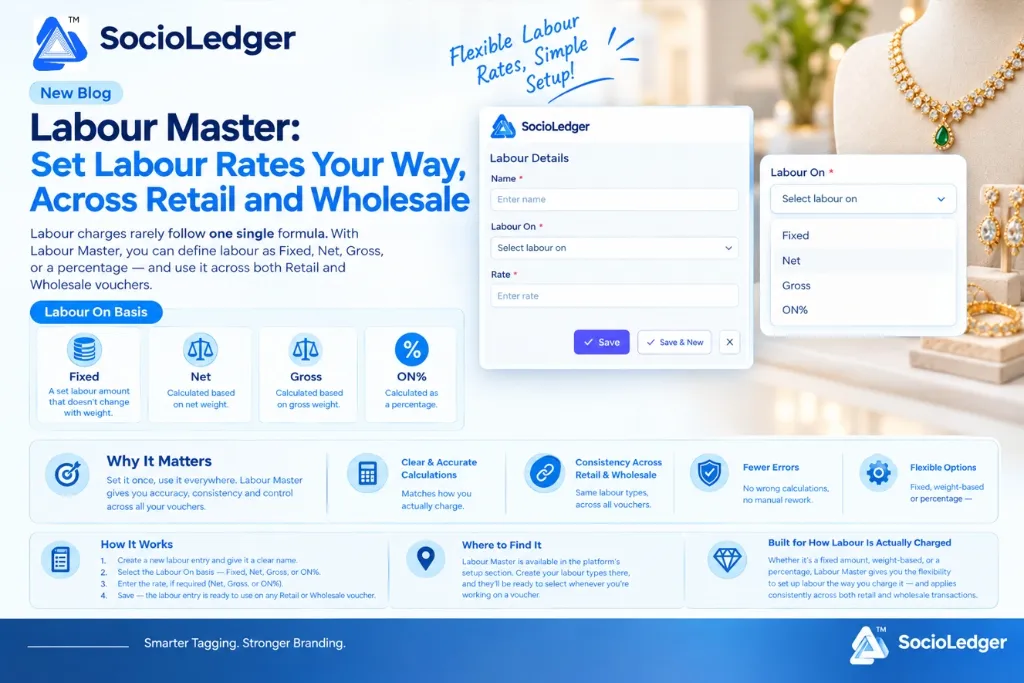
Table of contents
Open Table of contents
- The challenge of manual labour charge calculations in jewelry businesses
- What is Labour Master?
- The four Labour On calculation methods explained
- Comparison of Labour On calculation types
- Dynamic rate setup: smart fields that adapt to your choice
- Why Labour Master matters: 4 key operational advantages
- How it works: 4 simple steps to set up and use Labour Master
- Where to find Labour Master in SocioLedger
- Built for how jewelry labour is actually charged
The challenge of manual labour charge calculations in jewelry businesses
In major jewelry trading hubs like Zaveri Bazaar, Rajkot, Karol Bagh, Surat, and Coimbatore, pricing a piece of jewelry involves far more than just multiplying fine gold weight by the current bullion rate. Making charges (labour) represent the skill, craftsmanship, casting precision, and design intricacy invested into each ornament.
However, different ornament categories and customer channels demand completely different labour pricing formulas:
- Machine-made chains and cast bangles are typically charged on net metal weight per gram.
- Studded rings and gemstone jewelry may use gross weight to account for stone setting labour or use a flat piece-rate.
- Intricate bridal necklaces and antique sets often command a percentage-based charge tied to the prevailing gold value.
- Standard hallmarked bullion or coins might have a simple fixed handling charge per unit.
When counter sales staff or wholesale dispatch operators must calculate these diverse formulas manually on every single transaction, several operational problems arise:
- Slow billing counters: Calculating different labour formulas by hand on every voucher creates unnecessary wait times for retail customers during festival rushes like Dhanteras and Akshaya Tritiya.
- High risk of calculation errors: Applying a net weight rate to a gross weight piece or miscalculating a percentage formula leads to immediate revenue leakage or awkward customer disputes.
- Inconsistent pricing between branches and counters: Without centralized master rates, different sales associates might quote varying making charges for identical pieces.
- Friction across sales channels: Wholesalers and retailers often use different calculation conventions; re-entering these numbers manually across wholesale estimates and retail tax invoices doubles the administrative workload.
Labour Master solves this by centralizing your making charge logic into structured, reusable master profiles.
What is Labour Master?
Labour Master is a dedicated setup module in SocioLedger that allows jewelers to predefine standardized labour profiles with customized names, calculation bases, and rates.
Instead of typing formulas or doing manual arithmetic on invoices, you simply select the appropriate labour entry from a dropdown menu. SocioLedger automatically computes the exact labour amount based on the item’s weight, value, or piece count.
+-----------------------------------------------------------------------------+
|                    SocioLedger Labour Master Calculation Basis              |
+-----------------------------------------------------------------------------+
|  1. FIXED   --> Flat charge independent of metal weight (e.g., ₹500/piece)  |
|  2. NET     --> Charged per gram on Net Gold Weight (e.g., ₹450/gram net)   |
|  3. GROSS   --> Charged per gram on Gross Item Weight (e.g., ₹380/gram gross)|
|  4. ON%     --> Charged as percentage of metal/item value (e.g., 8.5% on gold)|
+-----------------------------------------------------------------------------+
The four Labour On calculation methods explained
Every jewelry business has its own pricing strategies. Labour Master provides four distinct Labour On bases to match the exact way you charge:
1. Fixed — Flat amount per piece
The Fixed labour basis applies a set monetary amount that does not change regardless of the item’s weight or purity.
- How it works: You enter a total fixed fee (for example, ₹750 per piece).
- When to use it: Ideal for standard casting items, silver artifacts, lightweight nose pins, coin packaging charges, or minimum repair fees where weight variations do not impact making costs.
- Voucher behavior: When selected on a voucher, the fixed amount is added directly to the line item without multiplying by gram weight.
2. Net — Calculated based on net weight
The Net labour basis calculates the labour fee strictly on the net metal weight (gross weight minus stone and enamel weights).
- How it works: SocioLedger multiplies the defined per-gram rate by the net weight of the ornament (
Labour Amount = Net Weight × Rate). - When to use it: Standard for 22K and 18K plain gold jewelry, machine chains, mangalsutras, and lightweight bangles where making charges are strictly tied to the actual gold content.
- Voucher behavior: When applied, the system reads the net weight field of the line item and computes the exact total making charge automatically.
3. Gross — Calculated based on gross weight
The Gross labour basis calculates the labour fee across the total gross weight of the ornament, including stones, pearls, beads, and findings.
- How it works: SocioLedger multiplies the defined per-gram rate by the gross weight of the piece (
Labour Amount = Gross Weight × Rate). - When to use it: Widely used for studded jewelry, cz-studded bangles, jadau, kundan pieces, or wholesale casting lots where handling and setting costs are assessed on the complete piece weight.
- Voucher behavior: The voucher multiplies the gross weight by your master rate, ensuring stone weight handling costs are automatically factored in.
4. ON% — Calculated as a percentage
The ON% labour basis calculates making charges as a direct percentage of the metal value or line item base price.
- How it works: You define a percentage rate (for example, 10% or 12.5%). SocioLedger calculates the labour as a percentage of the calculated gold value (
Labour Amount = Metal Value × Percentage Rate / 100). - When to use it: Preferred by designer showrooms, high-end bridal boutiques, and international retail counters where craftsmanship is billed proportionately to the gold value rather than a flat per-gram fee.
- Voucher behavior: If the gold rate fluctuates, the calculated labour scales automatically with the metal value.
Comparison of Labour On calculation types
Here is how the four calculation bases compare in everyday jewelry operations:
| Labour On Basis | Calculation Formula | Typical Jewelry Application | Rate Field Required |
|---|---|---|---|
| Fixed | Fixed Flat Fee | Silver coins, nose pins, minimal casting pieces, repair charges | No (Flat amount) |
| Net | Net Weight (g) × Per-Gram Rate | Plain 22K gold jewelry, cast bangles, machine-made chains | Yes (Rate per gram) |
| Gross | Gross Weight (g) × Per-Gram Rate | Studded items, CZ jewelry, wholesale casting lots with stones | Yes (Rate per gram) |
| ON% | Metal Value × (Percentage Rate / 100) | High-end designer pieces, bridal sets, export orders | Yes (Percentage rate) |
Dynamic rate setup: smart fields that adapt to your choice
Setting up a new labour profile in SocioLedger is fast and responsive. The interface dynamically adapts based on the basis you select:
+-----------------------------------------------------------------------------+
|                         Labour Details Setup Window                         |
+-----------------------------------------------------------------------------+
|  NAME *      : [ 22K Casting Machine Polish Bangles                       ] |
|  LABOUR ON * : [ Net                                                    ▼ ] |
|  RATE *      : [ 450.00                                                   ] |
|                                                                             |
|                [ ✓ Save ]     [ ✓ Save & New ]     [ ✕ Cancel ]             |
+-----------------------------------------------------------------------------+- Name: Give your labour entry an easily identifiable name (e.g., “22K Plain Bangles (Net)”, “Bridal Necklace Special 12%”, or “Studded Rings (Gross)”).
- Labour On: Choose between
Fixed,Net,Gross, orON%. - Rate: Once you select Net, Gross, or ON%, the dynamic Rate field appears automatically so you can enter the specific per-gram rate or percentage figure. For Fixed entries, the rate field remains inactive or preset, keeping your data entry clean.
- Action Buttons: Save your profile with Save, or use Save & New to quickly batch-create multiple labour master entries in a single session.
Why Labour Master matters: 4 key operational advantages
Centralizing your labour rates in SocioLedger delivers immediate benefits across your store counters and back-office operations:
1. Set it once, use it everywhere
Define a labour type and its rate a single time in your master settings, instead of recalculating or retyping rates on every transaction. Counter staff simply pick the profile name from the list, saving valuable time during every sale.
2. Matches how you actually charge
Whether your workshop charges a flat fee, ties labour to net or gross gram weight, or charges a percentage of total metal value, Labour Master supports the exact pricing structure your business relies on. You never have to force your pricing into an ill-fitting formula.
3. Consistency across Retail and Wholesale vouchers
The same Labour Master entries are available across both Retail vouchers (tax invoices, retail estimates, sales orders) and Wholesale vouchers (wholesale issue, wholesale delivery, dealer vouchers). Pricing logic remains uniform whether you are selling a single ring to a walk-in retail customer or dispatching bulk trays to a wholesale partner.
4. Fewer errors and zero manual rework
With the rate and basis defined upfront, there is no risk of counter staff applying the wrong labour calculation formula or mistyping a per-gram rate. Accurate calculations protect your showroom margins and eliminate awkward recalculations in front of customers.
How it works: 4 simple steps to set up and use Labour Master
Getting started with Labour Master in SocioLedger takes less than a minute:
- Create a new labour entry: Open the Labour Master setup screen and enter a clear, descriptive name for your labour type.
- Select the Labour On basis: Pick Fixed, Net, Gross, or ON% based on how that ornament category is priced.
- Enter the rate: If you selected Net, Gross, or ON%, enter the specific per-gram rate or percentage in the Rate field.
- Save and use: Click Save. The labour entry is now immediately ready to select on any Retail or Wholesale voucher across the platform.
+-----------------------------------------------------------------------------+
|                     Labour Master 4-Step Setup Flow                         |
+-----------------------------------------------------------------------------+
|  ┌─────────────┐     ┌─────────────┐     ┌─────────────┐     ┌─────────────┐|
|  │ 1. Define   │ ──> │ 2. Select   │ ──> │ 3. Enter    │ ──> │ 4. Save &   │|
|  │ Entry Name  │     │ Basis Type  │     │ Rate Value  │     │ Apply Everywhere│|
|  └─────────────┘     └─────────────┘     └─────────────┘     └─────────────┘|
+-----------------------------------------------------------------------------+
Where to find Labour Master in SocioLedger
Labour Master is available as its own dedicated configuration section within SocioLedger’s setup masters.
Once configured, your labour profiles appear automatically in dropdown pickers across all transaction screens — seamlessly integrating with our broader jewelry management ecosystem:
- Inventory and Tagging: Pair labour profiles with our item types and 1-click save and create tag button for rapid stock onboarding.
- Billing and Compliance: Streamline customer checkout and invoicing with GST billing for jewelry businesses.
- Bullion Reconciliations: Manage your metal accounts and payments with our payment receipt rate cut shortcut.
- Stock Tracking: Keep total visibility over precious metal balances with jewelry inventory management.
Built for how jewelry labour is actually charged
Labour pricing in the jewelry industry is never one-size-fits-all. A handmade kundan set cannot be priced using the same making charge formula as a machine-cut chain or a silver coin.
With Labour Master, SocioLedger gives jewelers the flexibility to define labour exactly the way they charge it — whether that is a fixed fee, weight-based on net or gross, or a percentage — and applies that logic consistently across both retail and wholesale transactions.
Have another pricing structure that needs its own master? Tell us — contact our team and we’ll look into it.