
A loan is more than an amount — it is a promise with dates attached: when it starts, when it ends, and when interest falls due along the way. In the fast-moving jewelry trade, if those payout dates live only in someone’s memory, a notebook, or a loose WhatsApp message, a missed collection or payment is just a matter of time. SocioLedger’s Loans module keeps the whole loan in one place, and its new Expected Interest Schedule displays every due date and interest amount before you even save the transaction.
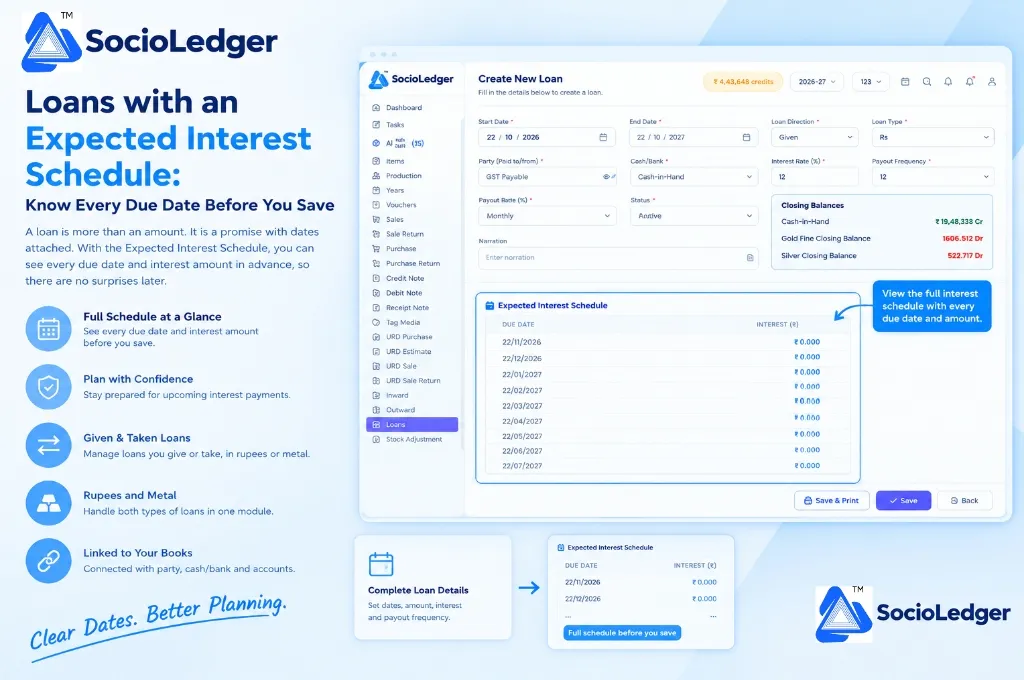
Table of contents
Open Table of contents
- Why informal loan dates create blind spots for jewelers
- What you can record in the Loans module
- What’s new: Expected Interest Schedule preview
- Verify closing balances before you commit
- Why the Expected Interest Schedule matters for jewelers
- How it works: step-by-step loan creation
- Notebook entries vs. SocioLedger Expected Interest Schedule
- Where to find the Loans module in SocioLedger
- Part of an integrated jewelry management ecosystem
- A loan whose dates are never a mystery
Why informal loan dates create blind spots for jewelers
Financial lending and borrowing happen every single day across jewelry hubs like Zaveri Bazaar, Surat, Rajkot, and Karol Bagh. A showroom owner might advance short-term capital to a supplier, borrow liquidity from an associate to stock up ahead of Dhanteras, or lend pure gold fine bars to a manufacturing workshop to meet an urgent custom order.
When these agreements are handled informally, the trouble rarely comes from the principal amount itself — it comes from the timeline:
- Forgotten payout intervals: Knowing that interest is due monthly is very different from knowing that the next check or metal transfer is due specifically on the 22nd of each month.
- Mental math errors: Calculating monthly interest on varying terms, amounts, and annual percentage rates creates discrepancies between parties.
- Disconnected bookkeeping: Recording a loan without seeing the current ledger balances or cash-in-hand position leads to over-extension or inaccurate books.
- Metal versus cash ambiguity: When loans alternate between physical fine metal (grams of 999 gold or silver) and Indian Rupees, tracking obligations requires absolute clarity.
When due dates are fuzzy, relationships suffer and cash flow planning stalls. Jewelers need a system where every future due date and payment milestone is mapped out clearly before committing an entry to the books.
+---------------------------------------------------------------------------------------------------+
|                           SocioLedger Loan & Interest Schedule Engine                             |
+---------------------------------------------------------------------------------------------------+
|                                                                                                   |
|    [ Loan Parameters ]                                                                            |
|    • Start Date: 22/10/2026        • End Date: 22/10/2027                                         |
|    • Direction: Given / Taken      • Type: Rs / Metal                                             |
|    • Amount / Weight: ₹ Value      • Rate (%): 12% p.a.          • Frequency: Monthly             |
|                                                                                                   |
|                                           │                                                       |
|                                           ▼                                                       |
|    ┌─────────────────────────────────────────────────────────────────────────────────────────┐    |
|    │                       Dynamic Expected Interest Schedule Engine                         │    |
|    ├─────────────────────────────────────────────────────────────────────────────────────────┤    |
|    │  DUE DATE           INTEREST (₹)             STATUS / ACTION                            │    |
|    │  ─────────────────────────────────────────────────────────────────────────────────────  │    |
|    │  22/11/2026         ₹ Calculated Amount      Projected upcoming monthly installment    │    |
|    │  22/12/2026         ₹ Calculated Amount      Projected upcoming monthly installment    │    |
|    │  22/01/2027         ₹ Calculated Amount      Projected upcoming monthly installment    │    |
|    │  ...                ...                      ...                                        │    |
|    │  22/10/2027         ₹ Calculated Amount      Final payout & loan maturity              │    |
|    └─────────────────────────────────────────────────────────────────────────────────────────┘    |
|                                           │                                                       |
|                                           ▼                                                       |
|    ┌─────────────────────────────────────────────────────────────────────────────────────────┐    |
|    │                         Pre-Save Live Balance Verification                              │    |
|    │  Party Ledger Closing Balance        │  Cash/Bank Closing Balance                       │    |
|    │  ₹ Balance | Gold Fine | Silver      │  ₹ Balance | Gold Fine | Silver                  │    |
|    └─────────────────────────────────────────────────────────────────────────────────────────┘    |
|                                           │                                                       |
|                                           ▼                                                       |
|                           [ Save ]  or  [ Save & Print ]                                          |
|                                                                                                   |
+---------------------------------------------------------------------------------------------------+
What you can record in the Loans module
The Loans module gives you complete control over your financing transactions. Whether you are extending funds or receiving capital, every parameter is captured in a structured format:
- Start Date and End Date: The full calendar term the loan runs for.
- Loan Direction: Select Given for loans you extend to parties, or Taken for loans you receive.
- Loan Type: Choose Rs for monetary loans in rupees, or Metal for loans transacted in physical fine gold or silver.
- Party (Paid To/From): Link the loan directly to the appropriate customer, vendor, bullion supplier, or financing partner ledger.
- Cash/Bank: The exact cash drawer or bank ledger account the transaction moves through.
- Amount: The total financial value or principal loan amount.
- Interest Rate (%): The agreed annual or periodic interest percentage.
- Payout Frequency: The distribution cycle for interest payments, such as monthly, quarterly, or on maturity.
- Status: The operational state of the loan, such as Active or Pending.
- Narration: An optional note or terms summary to retain full audit context.
While filling in the form, closing balances for both the selected party and the cash or bank account appear right on screen. You see the Rupee balance alongside the Gold Fine and Silver balances, allowing you to verify liquidity and outstanding credit before saving.
What’s new: Expected Interest Schedule preview
Below the loan entry form, the Expected Interest Schedule automatically generates a clean, itemized timeline across the entire life of the loan.
Instead of waiting for an installment to arrive or relying on manual calendar reminders, the table lists:
- Every Due Date: Each date an interest payment falls due, arranged chronologically from the start date to the maturity date.
- Expected Interest Amount: The exact interest figure calculated in Rupees expected on each specific date.
- Dynamic Adjustments: When you adjust the principal amount, modify the interest rate percentage, or switch the payout frequency, the schedule updates instantly before your eyes.
For example, on a one-year loan of ₹10,00,000 at 12% annual interest with a monthly payout frequency, the Expected Interest Schedule instantly maps out all 12 monthly milestones. You can see the full schedule, review the due dates, and confirm the figures with your counterparty before committing the record.
+-----------------------------------------------------------------------------+
|                          Expected Interest Schedule                         |
+-----------------------------------------------------------------------------+
|  DUE DATE                 INTEREST (₹)                                      |
+---------------------------+-------------------------------------------------+
|  22/11/2026               ₹ 10,000.00                                       |
|  22/12/2026               ₹ 10,000.00                                       |
|  22/01/2027               ₹ 10,000.00                                       |
|  22/02/2027               ₹ 10,000.00                                       |
|  22/03/2027               ₹ 10,000.00                                       |
|  22/04/2027               ₹ 10,000.00                                       |
|  22/05/2027               ₹ 10,000.00                                       |
|  22/06/2027               ₹ 10,000.00                                       |
|  22/07/2027               ₹ 10,000.00                                       |
|  22/08/2027               ₹ 10,000.00                                       |
|  22/09/2027               ₹ 10,000.00                                       |
|  22/10/2027               ₹ 10,000.00                                       |
+-----------------------------------------------------------------------------+
Verify closing balances before you commit
Entering a loan without visibility into your existing books leads to costly cash flow errors. In SocioLedger, the moment you pick a counterparty ledger and a cash or bank account, the interface displays their live closing balances:
- Party Closing Balances: Shows the current financial standing (Debit/Credit in ₹) as well as any outstanding pure metal balances (Gold Fine Dr/Cr and Silver Dr/Cr).
- Cash or Bank Closing Balances: Confirms available cash-in-hand or bank liquidity so you never approve a loan that overdraws your reserves.
Reviewing these balances alongside the Expected Interest Schedule means both sides of the transaction are verified before anything is saved.
+-----------------------------------------------------------------------------+
|                             Closing Balances Box                            |
+-----------------------------------------------------------------------------+
|  Cash-in-Hand:                 ₹ 19,48,338.00 Cr                            |
|  Gold Fine Closing Balance:        1606.512 g Dr                            |
|  Silver Closing Balance:            522.717 g Dr                            |
+-----------------------------------------------------------------------------+
Why the Expected Interest Schedule matters for jewelers
Having complete visibility over your loan timelines changes how you manage day-to-day liquidity and counterparty relationships.
1. No surprises later
Every due date is visible from the exact second you configure the loan. There is zero confusion down the line about when interest should be received or remitted.
2. Plan ahead with confidence
Cash flow visibility is essential for jewelry showroom operations. When you know exactly what interest income is arriving or what obligations are due month by month, planning inventory purchases and bullion bookings becomes predictable.
3. Both directions covered
Whether you are extending capital to another trade business (Given) or borrowing operating funds (Taken), the same transparent schedule applies. Both sides of your lending activity remain clear and balanced.
4. Rupees and metal in one module
Jewelry businesses frequently lend or borrow metal weight alongside cash. SocioLedger keeps rupee loans and metal-based loans organized under a single roof, avoiding fragmented notebooks or disjointed spreadsheets.
5. Linked directly to your books
Each loan entry connects a party ledger with a cash or bank account. There is no duplicate journal entry required later — everything stays synchronized with your general ledger.
6. Easy to review later
The loan directory displays each loan’s start and end dates, direction, type, party, cash or bank account, and amount or metal weight. You can review all active, completed, or pending agreements together in one filtered list.
How it works: step-by-step loan creation
Creating a loan with an Expected Interest Schedule in SocioLedger takes less than a minute:
- Open Loans: In the main navigation menu, click Loans and select the option to create a new loan.
- Set dates, direction, and type: Choose your Start Date and End Date, set the Loan Direction (Given or Taken), and select the Loan Type (Rs or Metal).
- Select party and cash/bank: Pick the counterparty ledger and your cash or bank account. Check the live closing balances displayed on screen.
- Enter financial terms: Fill in the loan amount, interest rate percentage, and select the payout frequency (such as monthly).
- Review Expected Interest Schedule: Inspect the generated schedule table at the bottom of the screen to confirm every due date and interest payout amount.
- Save or Save & Print: Click Save to record the transaction, or choose Save & Print to immediately produce a formal physical document for your files.
Notebook entries vs. SocioLedger Expected Interest Schedule
| Operational Aspect | Traditional Diaries & Spreadsheets | SocioLedger Loans Module |
|---|---|---|
| Due Date Visibility | Buried in notes or remembered manually | Complete schedule of dates generated upfront |
| Interest Calculation | Manual calculations prone to disputes | Automatic interest breakdown for every cycle |
| Schedule Changes | Requires recalculating every installment | Dynamically recalculates when terms change |
| Pre-Save Balances | Blind entry with zero ledger context | Live party and cash/bank balances visible |
| Given & Taken | Separate loose sheets or fragmented tabs | Unified tracking for both lending directions |
| Metal & Rupee Loans | Difficult conversions and split records | Native support for Rupees and Fine Metal |
| Voucher Printing | Hand-written chits or manual slips | One-click Save & Print documentation |
Where to find the Loans module in SocioLedger
The Loans module is available as its own dedicated section in the primary SocioLedger sidebar.
From the Loans dashboard, you can view all active and settled loans, filter records by party or loan type, monitor maturity dates, and click into any loan to inspect its full payout history.
Part of an integrated jewelry management ecosystem
The Loans module works in harmony with SocioLedger’s broader suite of financial and jewelry management tools:
- Smart Ledger Dashboard: Check comprehensive party histories and account statements with the smart ledger dashboard.
- Field-Wise Search: Quickly locate any customer, artisan, or financier account using field-wise ledger search.
- Rate Cut Shortcuts: Settle metal liabilities and fix gold prices easily using payment receipt rate cut shortcuts.
- Audit Security: Keep all financial records safe and trace user activities with role-based access control.
A loan whose dates are never a mystery
Good records mean you never have to ask “when is that interest due?” With the Expected Interest Schedule, jewelers can see the full timeline of every loan up front, and keep given and taken loans in rupees or metal in one organized place.
Have a lending scenario we haven’t covered? Tell us — contact our team and let us help you streamline your jewelry business financing.